

A restaurant owner expects a slower January, sets a sales target, and plans labor accordingly. Then a major snowstorm closes the restaurant for several days. The original plan still has value, but the owner now needs a current view of what the interruption means for cash, payroll, and the rest of the quarter. That practical distinction is the difference between budget and forecast.
Both tools help small business owners plan with more confidence. But they answer different questions. A budget establishes the financial plan you intend to follow. A forecast estimates where the business is now likely to land based on current results and changing conditions. When your books are current and your reports are accurate, you can use both without treating either one as a guess.
What a budget is designed to do
A budget is a financial plan for a future period, often a calendar year or fiscal year. It sets expectations for revenue, direct costs, payroll, overhead, debt payments, and planned investments. It gives your business a framework for deciding what you can afford before money is spent.
For example, a Worcester landscaping company might build an annual budget that anticipates most revenue between April and November. The owner may budget for seasonal payroll, equipment repairs, insurance, fuel, and a winter cash reserve. Those figures are based on prior results, known contracts, pricing decisions, and reasonable assumptions about the coming year.
The purpose is not to predict every dollar perfectly. It is to create an intentional operating plan. A good budget helps you set sales goals, establish spending limits, price work appropriately, and determine whether planned hiring or equipment purchases are realistic.
Because it is a plan, a budget is usually approved before the period begins and does not change every time a monthly result differs from expectations. If you revise it constantly, it becomes harder to see whether performance was above or below the original plan.
A budget creates accountability
Comparing actual results to budget gives owners useful questions to investigate. If monthly revenue is lower than budgeted, is the issue sales volume, customer retention, pricing, timing, or an estimate that was too optimistic? If payroll is higher than expected, did overtime increase, did staffing change, or were labor costs not built into pricing?
Those comparisons are commonly called budget-to-actual variances. They are not a report card. They are a way to identify what happened and decide whether action is needed. A variance may be completely reasonable, such as a planned increase in marketing that produced stronger sales. The value comes from understanding the reason behind it.
What a forecast is designed to do
A forecast is an updated estimate of future financial results. It starts with what has actually happened and incorporates the best information available now. It is more flexible than a budget because its job is to support current decisions, not preserve an original assumption.
Suppose that same landscaping company budgeted $600,000 in annual revenue. By the end of May, completed work is ahead of plan, but summer drought conditions are reducing demand for certain services. The owner can use actual year-to-date revenue, booked jobs, open proposals, current labor costs, and expected expenses to forecast the remainder of the year.
The result may show projected annual revenue of $625,000, $590,000, or something else entirely. More importantly, it can show whether cash will be available when insurance renewals, equipment repairs, and payroll obligations come due.
A forecast can cover the next month, quarter, or full year. Many small businesses benefit most from a rolling forecast that is updated monthly and looks ahead 3 to 12 months. The appropriate horizon depends on the business. A retail shop with seasonal inventory may need close attention to the next several months, while a professional-services firm with longer client contracts may be able to forecast further ahead.
Budget vs. forecast: the practical difference
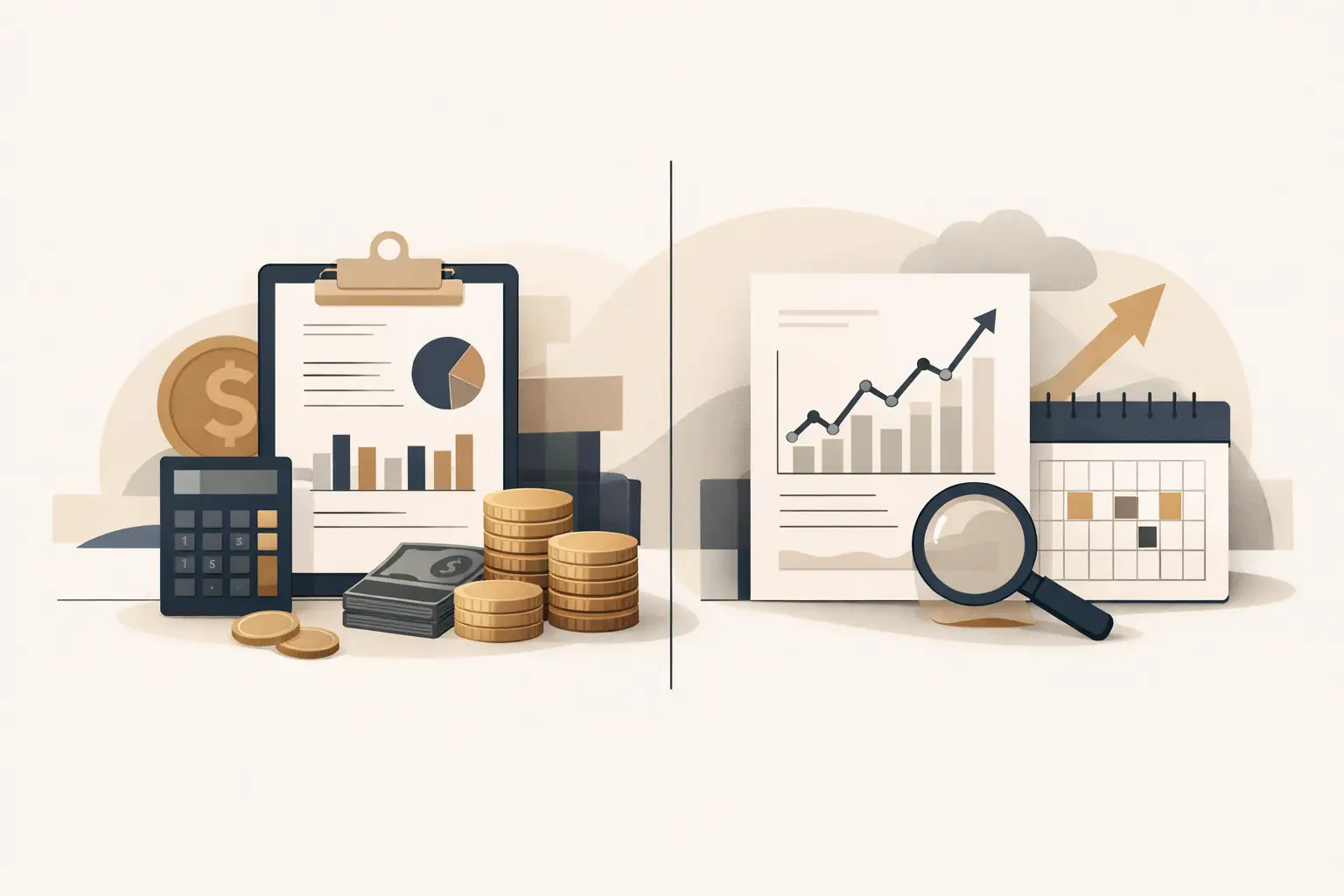
The simplest way to remember the distinction is this: the budget says, “Here is our plan.” The forecast says, “Based on what we know now, here is where we are headed.”
A budget is generally more fixed, while a forecast should be updated as meaningful new information becomes available. A budget is useful for setting targets and evaluating performance. A forecast is useful for managing cash, staffing, purchasing, and near-term risk.
Neither tool replaces the other. Relying only on a budget can leave an owner tied to assumptions made months ago. Relying only on a forecast can make it difficult to measure performance against a deliberate plan. Together, they create a clearer management rhythm: set a direction, review results, adjust your outlook, and make decisions before a problem becomes urgent.
Why cash flow makes the distinction more urgent
Profit and cash are related, but they are not the same. A business can show a profit on its income statement while facing a cash shortage because customers have not paid, inventory was purchased in advance, loan payments are due, or payroll timing changed.
That is why a forecast should include cash flow, not just projected sales and expenses. A cash forecast estimates when money will actually come in and go out. It can help answer questions such as whether you can make payroll comfortably, whether a large purchase should wait, or whether you need to follow up on overdue invoices.
Consider a contractor that wins several profitable projects. The budget may show the company is on track for a strong year. But if materials must be paid for before customer deposits arrive, the short-term cash forecast may show pressure in the next four weeks. That does not mean the work is unprofitable. It means the owner needs a plan for timing, billing, deposits, or financing.
Clean, timely bookkeeping makes this possible. When transactions are months behind or account balances are not reconciled, any forecast is built on incomplete information. Current records give owners a dependable starting point rather than a bank balance that may not reflect bills, payroll liabilities, or incoming customer payments.
How to use both tools in a monthly routine
For most small businesses, the best process is straightforward. Build an annual budget before the year begins, using historical financial reports and known changes in the business. Then review actual results each month against that budget.
At the same time, update the forecast using current sales, confirmed work, likely expenses, payroll needs, receivables, and any changes in market conditions. The forecast should reflect reality, even when reality is less favorable than the plan. An overly optimistic forecast may feel better in the moment, but it delays decisions that could protect the business.
Your monthly review does not need to become a lengthy accounting exercise. Focus on a few practical questions:
- Are sales, gross margin, and operating expenses tracking close to plan?
- What changed since last month, and is it temporary or likely to continue?
- What does the updated outlook say about cash over the next 30, 60, and 90 days?
- Do you need to adjust spending, collections efforts, staffing, pricing, or purchasing?
For a very small business, this may be a 30-minute monthly meeting with accurate reports. For a growing company with payroll, multiple service lines, or tight margins, it may require more detailed reporting and scenario planning. The process should fit the complexity of the business, but skipping it entirely often leads to reactive decisions.
When should you revise the budget?
Not every variance requires a new budget. A one-time repair, a late customer payment, or a minor monthly sales swing may be better handled in the forecast. Reworking the budget for every change can erase the original benchmark and make it harder to learn from results.
A formal budget revision makes sense when the business has experienced a significant and lasting change. Examples include opening a new location, losing a major customer, adding a service line, changing pricing, making a major hire, or facing a substantial shift in costs. In those cases, a revised budget can provide a more useful plan for the remainder of the year.
The key is to document why the revision was made. That preserves clarity for future planning and prevents a difficult result from being hidden by a revised target.
Common mistakes that make both tools less useful
The first mistake is treating a budget as a promise rather than an estimate. Economic conditions, customer demand, weather, supplier pricing, and staffing can all change. The budget should guide decisions, not create false certainty.
The second is confusing revenue with cash available to spend. Sales projections matter, but payment timing, tax obligations, debt payments, and upcoming bills matter just as much.
The third is building plans from unreliable records. If last year’s income or expenses are inaccurate, next year’s budget will inherit those problems. Regular reconciliations and well-organized financial statements give planning a stronger foundation.
Finally, some owners create a budget once and never look at it again. A plan that is not reviewed cannot guide action. Even a simple monthly comparison can reveal issues early enough to respond thoughtfully.
A budget gives your business a destination. A forecast helps you steer when the road changes. With current books and a regular review process, the numbers become more than paperwork – they become practical guidance for the next decision in front of you.
Leave a Reply