

Here’s something most small business owners don’t know
Large corporations never rely on just one person to manage their finances. They have an entire financial team — a bookkeeper, a controller, and an accountant — each playing a distinct and critical role. Together, these three layers create a system of checks and balances that keeps the business accurate, compliant, and protected.
Most small businesses? They hire a bookkeeper and call it a day.
And that gap — the missing oversight — is exactly where costly mistakes, compliance issues, and financial blind spots quietly take root.
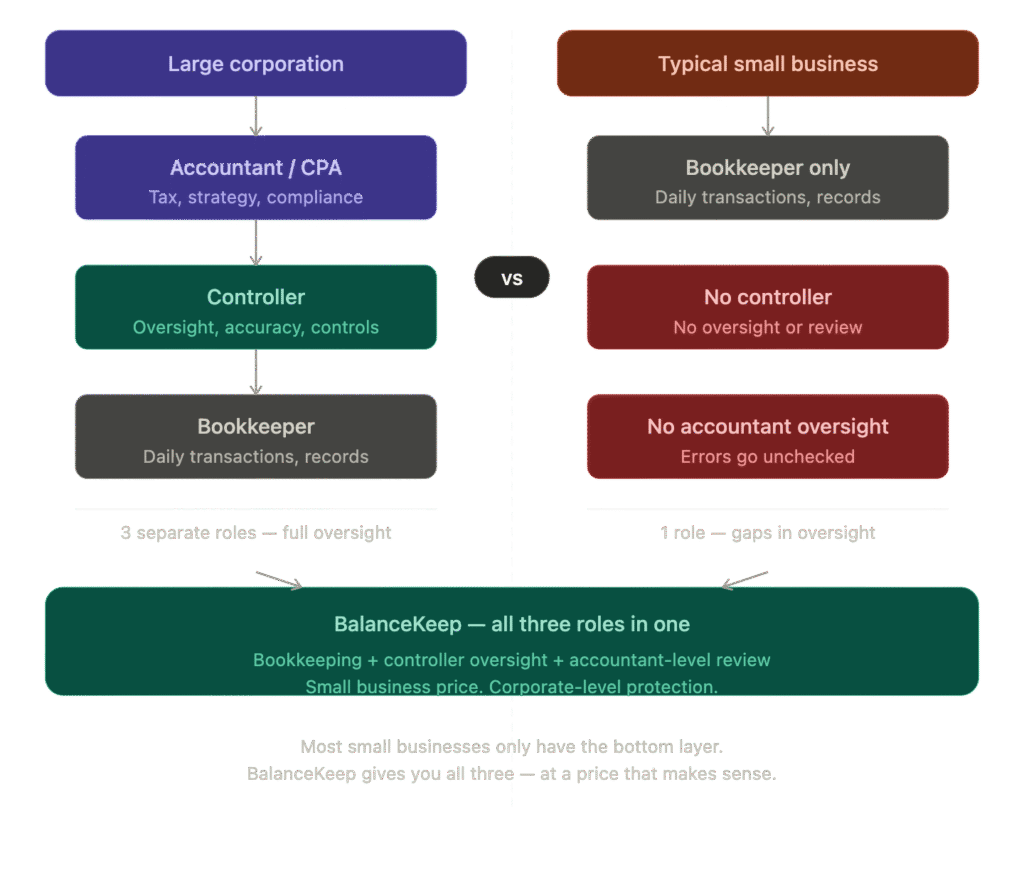
How Large Corporations Structure Their Finances
In any mid-to-large corporation, the financial department operates in three clear tiers:
The Bookkeeper handles daily transactions — recording income and expenses, reconciling accounts, managing accounts payable and receivable, and keeping the general ledger up to date.
The Controller sits above the bookkeeper and provides oversight — reviewing the bookkeeper’s work, catching errors, enforcing internal controls, and making sure nothing slips through the cracks.
The Accountant / CPA operates at the highest level — handling tax planning, financial strategy, regulatory compliance, and audit support.
The Small Business Reality
A business owner gets started, things get busy, and they hire a bookkeeper to handle the financial admin. But without a controller reviewing the bookkeeper’s work and without an accountant providing oversight, there is no one catching mistakes before they compound. Accounts get miscategorized. Tax liabilities get missed. Financial reports look fine on the surface — but the numbers underneath don’t tell the real story.
The 3 Most Common Issues When There’s No Oversight
1. Incorrect Chart of Accounts Setup
If a bookkeeper sets up your QuickBooks chart of accounts incorrectly from the start, every transaction that follows gets categorized wrong. By the time tax season arrives, your CPA is untangling months — sometimes years — of misclassified data. This is one of the most common and expensive problems we see. Not sure if your books are set up correctly? Read our guide on how to know it’s time for a QuickBooks cleanup.
2. Compliance Gaps
Sales tax, payroll tax, contractor classifications — these aren’t simple, and the rules change. Without someone with accountant-level knowledge reviewing your books, compliance issues can build up silently until they become IRS notices or penalties.
3. No One Is Catching Errors
A bookkeeper records what they see. But who is verifying it? In a corporation, the controller reviews the bookkeeper’s work every single month. In most small businesses, no one does. That means errors — even innocent ones — go undetected and compound over time. Understanding your cash flow is one of the first places these errors show up.
What Makes BalanceKeep Different
Most bookkeeping services give you a bookkeeper. BalanceKeep gives you all three layers of financial oversight — at a price built for small businesses.
As a QuickBooks ProAdvisor and accountant, BalanceKeep doesn’t just record your transactions. We set up your books correctly from day one, review them with an accountant’s eye every month, flag issues before they become problems, and make sure your financials are accurate, compliant, and ready for whatever comes next.
You get the protection of a full financial team. Without the cost of hiring one.
You Deserve More Than Just a Bookkeeper
Small businesses take on the same financial risks as large corporations — payroll, taxes, cash flow, compliance — often with far less margin for error. That’s exactly the gap BalanceKeep was built to fill.
Want to get ahead of your numbers? Start by reading 3 smart questions every small business owner should ask their bookkeeper each month.
👉 Schedule a Free Consultation
Let’s make sure your books aren’t just organized — they’re protected.